

Writing on cyber strategy, statecraft, operations, and geopolitics in a personal capacity. Views are my own and do not represent any employer or client. I use modern research and editing tools; analysis and judgement are mine.
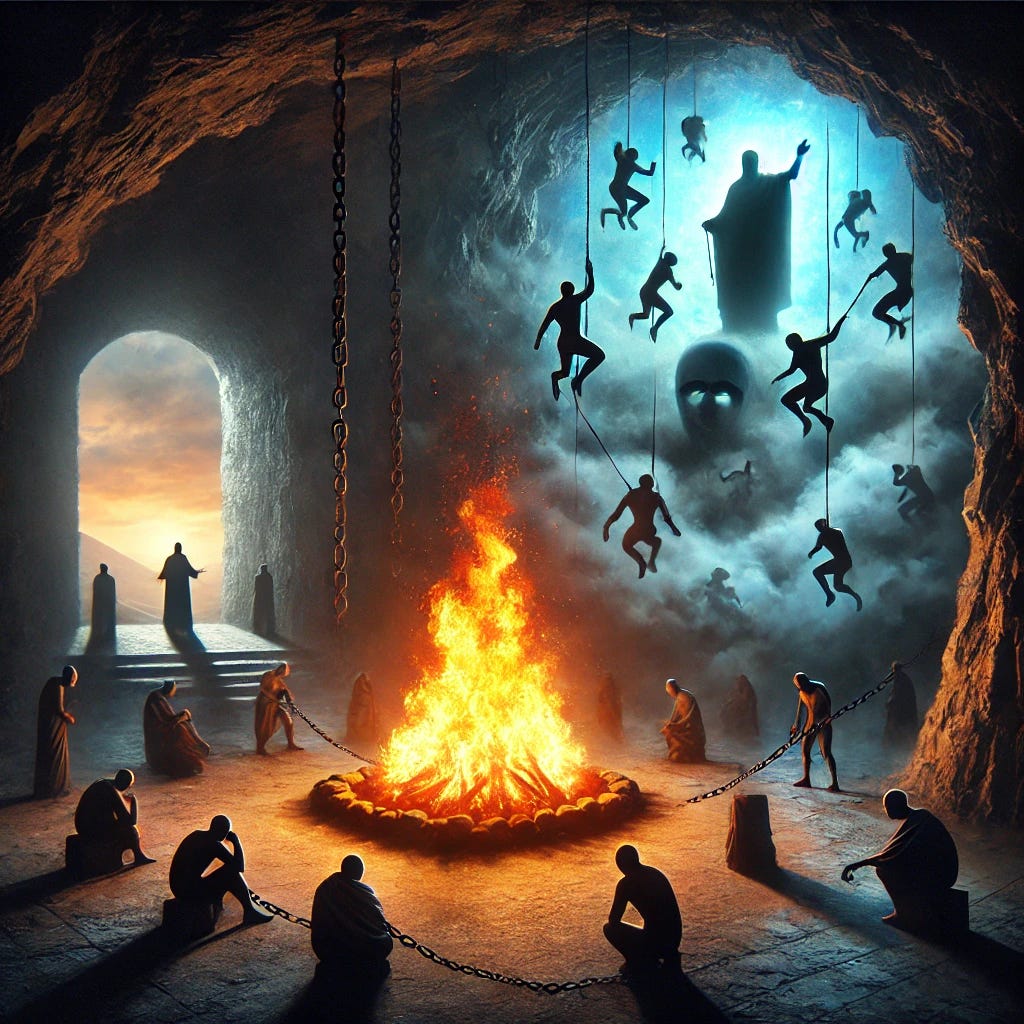
"The Fire of Illusions" - pictured generated by DALL·E, AI image-generation tool
In shadowed caves where echoes reign,
Men watch the walls and call it plain.
Bound by chains of whispered lore,
Truth is but the tale they swore.
The priests once spoke from altars high,
Marking stars upon the sky.
"This is light, this is dark,
Bow your head, ignite the spark."
But kings soon learned, with gilded pen,
That gods could rule through mortal men.
The papal seal, the emperor’s writ,
Turned holy tongues to politics.
Then came the press, the printed page,
A new machine, the war of age.
Monarchs fell, the truth stood free,
Yet money bought its sovereignty.
The radio hummed, the screens soon shone,
And every voice became a throne.
Wars were waged on what was real,
Truth was shaped by those who deal.
And now the net, the tangled sprawl,
A hundred flames, none true at all.
A million prophets, each their creed,
All selling doubt as holy seed.
The East weaves whispers in the mist,
The West cries out, yet both insist:
“We speak the light, they speak the lies.”
Yet truth, like smoke, still twists and flies.
And so we stand, axe in hand,
Chopping wood upon the land.
Before enlightenment, the fire burned,
After? Only lessons learned.
For truth’s no beacon, standing bright,
But a bonfire lit in the dead of night.
Fed by power, fanned by schemes,
A flickering wisp of shattered dreams.
So ask not what is truth, my friend,
But who has shaped it in the end.
The Bonfire of Truth – Reflections and Annotations
What is truth?
A simple question with an answer that has been shaped, twisted, and weaponized throughout history. From the shadows of Plato’s cave to the altars of religion, from monarchs' decrees to the algorithms that now dictate what we see, truth has always been less about objective reality and more about who holds the power to define it.
This poem started as a passing comment in a chat group, turned into a journal entry, then escalated into a late-night debate with my wife (which, for the record—and for my continued domestic peace—I definitely lost). The spark? A discussion about narratives in global geopolitics, particularly Peter Zeihan’s views on the Ukraine-Russia war, Western commentary, US politics, and China’s approach to information warfare.
But beyond the politics, this piece is something more personal. I’ve always been fascinated by the tug-of-war between perception and reality—how civilizations have built entire frameworks around belief, how power has always found a way to shape “truth,” and how, despite all our technological advancements, we are still just as susceptible to illusions as the prisoners in Plato’s cave. Maybe even more so.
This poem is my meditation on truth, power, and perception throughout history. It weaves together my understanding of philosophy, historical shifts in information control, and the cynical realities of modern narratives. Below, I’ve included a breakdown of the themes and references embedded in the lines—so you can see the thought process behind what I wrote and why.
In the end, I kept circling back to a line from Epictetus:
“It is impossible for a man to learn what he thinks he already knows.”
So here’s my take—a poem on the malleability of truth, shaped by my interest in history, philosophy, Stoicism, cyber security, and geopolitics. Hope it sparks some thoughts of your own.
1. Plato’s Cave and the Perception of Truth
In shadowed caves where echoes reign,
Men watch the walls and call it plain.
This is a direct nod to Plato’s Allegory of the Cave from The Republic. In his metaphor, prisoners are chained in a cave, only able to see shadows projected onto a wall. They mistake these shadows for reality because it is all they have ever known. The line highlights the idea that our perception of truth is often nothing more than reflections of deeper realities controlled by unseen forces.
2. Religion as the Original Shaper of Perception
The priests once spoke from altars high,
Marking stars upon the sky.
"This is light, this is dark,
Bow your head, ignite the spark."
Here, the poem references the role of organised religion in shaping societal beliefs. Throughout history, religious institutions have dictated moral and cosmological truths—claiming divine authority to define what is right, wrong, sacred, or heretical. This duality of light vs. dark reflects how structured narratives shape human behavior, often invoking divine legitimacy to command obedience.
3. The Transition to Political Power and Ideological Control
But kings soon learned, with gilded pen,
That gods could rule through mortal men.
The papal seal, the emperor’s writ,
Turned holy tongues to politics.
As empires rose, kings and rulers realised that controlling religious doctrine meant controlling the people. The Divine Right of Kings, the Holy Roman Empire, and imperial mandates all showcase this fusion of religious and political power. When the papal seal or an emperor’s decree determined ‘truth,’ it blurred the line between faith and governance.
4. The Printing Press and the Battle for Information
Then came the press, the printed page,
A new machine, the war of age.
Monarchs fell, the truth stood free,
Yet money bought its sovereignty.
This section touches on the Gutenberg press and the democratisation of knowledge. The printing press enabled the Reformation, the fall of absolute monarchies, and the spread of new ideologies. However, while information became more widely available, it also became commodified—truth no longer belonged to the clergy but to whoever controlled the press, the publishers, and later, the media.
5. Mass Media, Propaganda, and the 20th Century
The radio hummed, the screens soon shone,
And every voice became a throne.
Wars were waged on what was real,
Truth was shaped by those who deal.
This reflects the rise of mass media, propaganda, and information warfare. From World War II propaganda to the Cold War’s ideological battles, truth became a tool wielded by governments and corporations. The advent of television and radio ensured that controlling the narrative meant controlling entire populations. The phrase “those who deal” alludes to media moguls, intelligence agencies, and corporate interests shaping public perception for profit and power.
6. The Digital Age and the Chaos of Competing Truths
And now the net, the tangled sprawl,
A hundred flames, none true at all.
A million prophets, each their creed,
All selling doubt as holy seed.
This section encapsulates the internet’s role in fragmenting truth. Unlike past centuries where centralised authorities controlled narratives, today’s digital landscape has created an explosion of competing voices. From conspiracy theorists to state-sponsored misinformation campaigns, everyone claims to hold the ‘real’ truth. The phrase “selling doubt as holy seed” is a nod to how skepticism—once a tool for enlightenment—has been weaponised to erode trust in institutions, leaving people susceptible to manipulation.
7. Geopolitical Propaganda and the New Battlefields
The East weaves whispers in the mist,
The West cries out, yet both insist:
“We speak the light, they speak the lies.”
Yet truth, like smoke, still twists and flies.
This section moves into the realm of geopolitical information warfare, particularly between China, Russia, and Western powers. Every major global player claims to represent the light while casting their adversaries in shadow. China’s state-controlled media, Russian disinformation strategies, and Western corporate news spin all operate under the same fundamental principle: control the narrative, control the populace.
Yet, as the last line suggests, truth remains elusive—drifting like smoke, impossible to grasp fully.
8. Zen Philosophy and the Return to Simplicity
And so we stand, axe in hand,
Chopping wood upon the land.
Before enlightenment, the fire burned,
After? Only lessons learned.
This is inspired by the Zen proverb: "Before enlightenment, chop wood, carry water. After enlightenment, chop wood, carry water." It suggests that even after great revelations or awakenings, the fundamental nature of existence remains unchanged.
In the context of the poem, this passage questions whether uncovering ‘truth’ changes anything at all. Despite humanity’s endless search for certainty—through philosophy, religion, media, and war—the struggle remains the same.
9. The Final Cynical Reflection: Who Holds the Match?
For truth’s no beacon, standing bright,
But a bonfire lit in the dead of night.
Fed by power, fanned by schemes,
A flickering wisp of shattered dreams.
Here, truth is likened not to a guiding light but to a bonfire—manipulated, fed, and controlled. The image of a bonfire in the night suggests that truth, far from being an objective force, is something that those in power construct and manipulate to serve their needs.
So ask not what is truth, my friend,
But who has shaped it in the end.
The final lines drive home the ultimate cynicism of the poem: truth is rarely a pure, objective reality. More often than not, it is a construct—crafted, shaped, and reshaped by those with the means to do so.
In the world of geopolitics, information warfare, and ideological battles, the question is not simply what is true? but who benefits from this version of truth?
Closing Thoughts
This poem and its accompanying reflections paint a picture of truth as a contested space, a tool of power, and a shifting illusion shaped by those in control. From ancient philosophy to modern geopolitics, the nature of truth has remained as much a battlefield as it has a mystery.
In a world where competing narratives drown each other out, perhaps the only certainty is that someone, somewhere, is holding the match.