

Writing on cyber strategy, statecraft, operations, and geopolitics in a personal capacity. Views are my own and do not represent any employer or client. I use modern research and editing tools; analysis and judgement are mine.
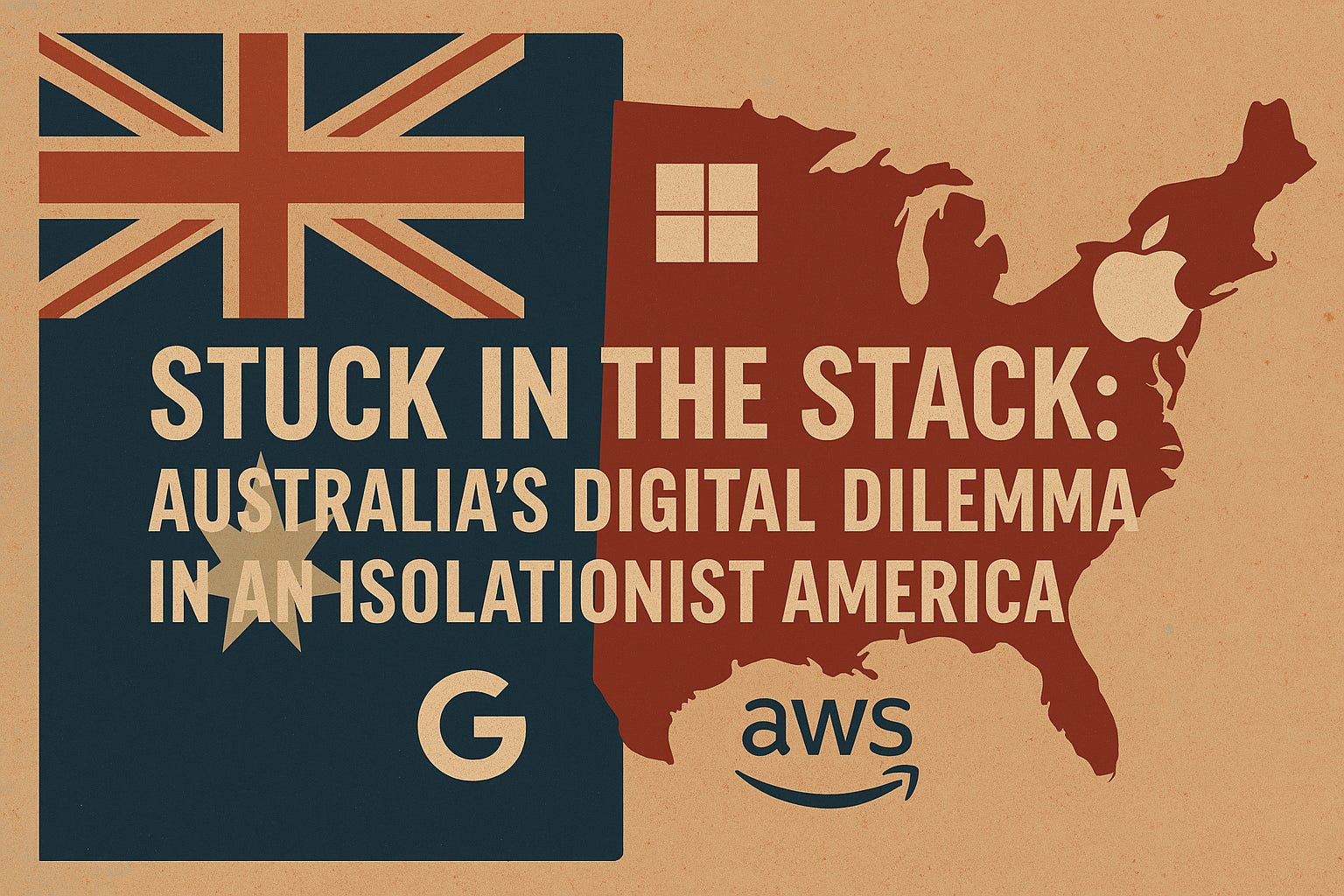
Trump’s back. Tariffs are flying. And “Liberation Day” is grabbing headlines across the globe. But behind the slogans lies something more consequential: a shift in U.S. economic posture that’s sending ripples well beyond America’s borders. For allies like Australia, it signals a broader inflection point—one that tests our economic resilience and raises deeper questions about where we’re exposed.
Australia isn’t the main target of America’s latest protectionist push, but we’re certainly not immune. A 10% tariff now applies to $23.9 billion worth of Australian exports—beef, pharmaceuticals, aluminium among them. The message, while not overt, is hard to miss: alignment matters.
And while tariffs dominate the headlines, they’re only part of the story. Beneath the trade tension lies a more enduring strategic concern—one that’s embedded in how we operate day to day: our deep reliance on U.S.-controlled digital infrastructure.
Visible Dependence – Trade Tensions in Sharp Relief
Let’s start with what we can quantify:
Beef exports, a key component of our trade relationship with the U.S., now face a 10% cost hike. Demand may remain high, but margins just got tighter.
Pharmaceuticals have been exempted—for now. That likely has more to do with global health supply chains than any special diplomatic carveout.
Mining, while not directly targeted, remains exposed to second-order effects if demand slows in China, South Korea, or Japan.
KPMG has projected that the tariff package could reduce Australia’s GDP by A$27 billion. That’s not theoretical—it’s fiscal pressure with real-world consequences. This isn't just about trade. It’s about how the world is reorganising itself.
At home, policymakers are weighing two competing instincts: align more closely to avoid collateral damage—or maintain strategic space. It’s not a left-right issue. It’s a resilience calculus.
The Hidden Dependency – Deeply Embedded Digital Reliance
But beyond the tariff sheets and customs codes lies another form of dependency—one that doesn’t show up on a shipping manifest.
Australia’s public and private sectors run on U.S.-controlled platforms:
AWS supports infrastructure for over 140 government agencies.
Microsoft 365 is now the de facto productivity suite across the federal landscape.
Azure and Google Cloud underpin critical services in finance, healthcare, and telecoms.
Apple and Android dominate mobile platforms. Google Search is near-universal.
These are exceptional technologies. But reliance, no matter how efficient, comes with risk. Not because the platforms are flawed, but because they exist within a different legislative and geopolitical context.
What happens if access is limited—not out of hostility, but through regulatory change? What happens if geopolitical tension triggers restrictions? We’ve seen both play out globally.
The question isn’t whether these platforms are trustworthy. It’s whether we have a contingency if conditions shift.
Rethinking Sovereignty – From Borders to Backends
Sovereignty once meant border control, defence capability, and national infrastructure. Today, it must also account for platform control, data jurisdiction, and the resilience of digital systems.
The U.S. has demonstrated it will use digital platforms as tools of statecraft—sometimes directly, sometimes through broader legal mechanisms like the CLOUD Act or export controls. This isn’t a criticism. It’s a recognition of how power is exercised in the 21st century.
Even allies must understand: access to core systems can become conditional. Not out of malice, but as a function of shifting strategic priorities. Resilience now requires more than strong firewalls. It requires structural optionality.
Building Digital Resilience: What It Actually Takes
So what does that look like in practice? Not panic. Not wholesale decoupling. But deliberate, strategic rebalancing:
Multi-cloud architectures – Prioritise design flexibility to avoid single points of failure.
Local capability uplift – Invest in domestic platforms for critical and high-sensitivity functions.
Trusted regional alliances – Collaborate with partners like Japan, South Korea, and EU nations on shared digital frameworks.
Critical infrastructure standards – Treat cloud and data platforms with the same scrutiny we apply to ports, grids, and pipelines.
Tech diversification as trade strategy – Just as we’ve expanded export markets, we must expand our tech stack.
A national digital sovereignty plan – A roadmap that aligns economic, cyber, and supply chain resilience into a single strategic narrative.
This isn’t about building digital fortresses. It’s about building optionality at scale.
Final Thought: Optionality is Strategic Strength
U.S. platforms will remain core partners. Their innovation and scale are unparalleled. But resilience demands more than efficiency. It demands the ability to pivot when circumstances change.
Sovereignty used to mean borders. Today, it means controlling your platforms, your data flows, and your digital identity.
In an era of multipolar technology and global interdependence, resilience isn’t just protection—it’s the ability to adapt.
If we want to navigate the future on our own terms, we need more than access. We need agency.
All views are my own. You can disagree. But the infrastructure still runs in Virginia.