

Writing on cyber strategy, statecraft, operations, and geopolitics in a personal capacity. Views are my own and do not represent any employer or client. I use modern research and editing tools; analysis and judgement are mine.
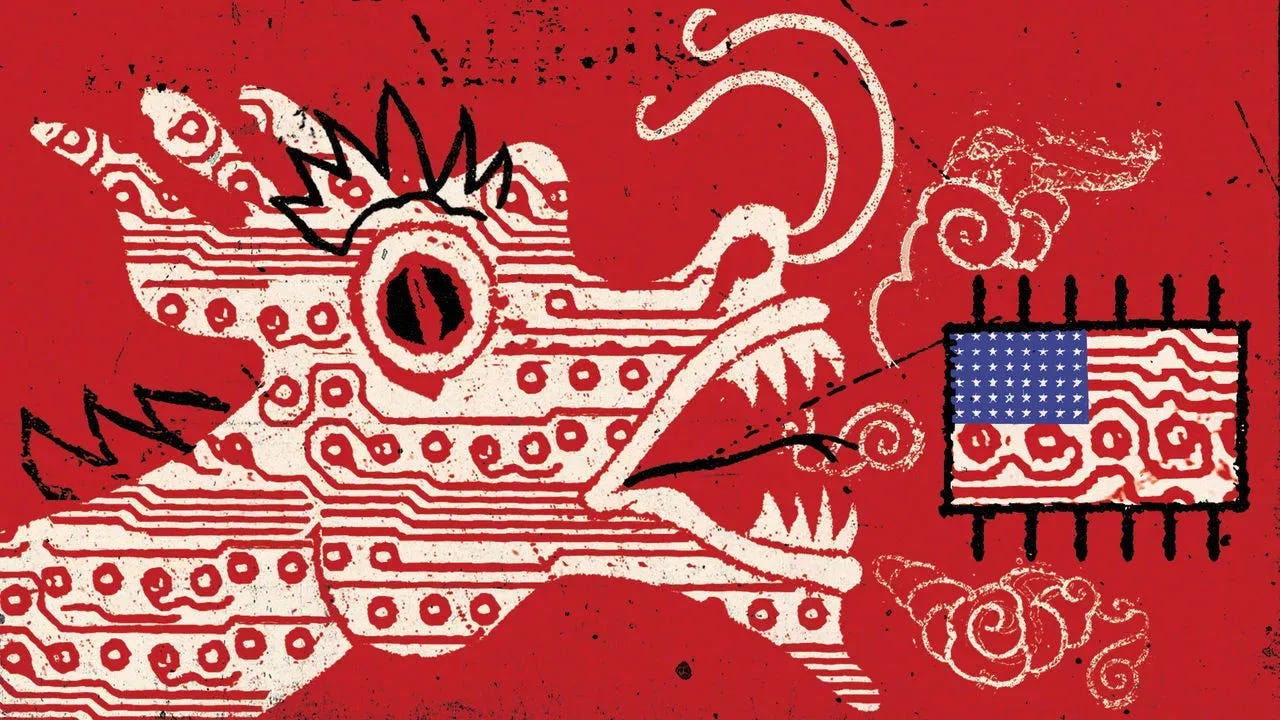
Illustration: Ben Jones The Economist: The front line of the tech war is in Asia
A Lifelong Fascination with the Great Game
As a kid, I spent hours poring over world maps, flipping through my Collins Encyclopedia (best present ever), and watching Sean Connery’s Bond navigate Cold War intrigue (Daniel Craig is my favourite Bond - just). That childhood curiosity evolved into a lifelong study of geopolitics, history, technology, and the great game—one that has taken me across China for over two decades, studying its language, culture, and philosophy firsthand.
Some will label me "pro-China" or even "pro-CCP." But I don’t see this as taking sides—I see it as understanding the full picture. Actually, in a playful homage to Russell Crowe’s Oscar acceptance speech: "Cheers to America! May China prosper! Kia Kaha, New Zealand! And thank the Southern Cross for Australia!"
Because let’s be clear—this debate isn’t just about DeepSeek, Huawei, or EVs. It’s about who controls the future. It’s about who sets the rules, who shapes the digital order, and who dominates the next era of global power.
Technology as a Contested Domain in the Great Power Competition
Technology is no longer just about innovation—it’s about leverage, influence, and control.
AI, semiconductors, quantum computing, and data governance have become the frontlines of great power competition.
China’s rapid advancements directly challenge U.S. dominance, accelerating the transition toward a multipolar world.
This shift forces us to ask:
Are we adapting to this new multipolar reality—or just reacting to it?
Are we critically assessing AI security risks—or defaulting to technological decoupling as a tool of strategic competition?
The Battle for the Digital Order: Competing Visions
This isn’t just about AI or cyber security. It’s about who writes the rules of the digital age.
For decades, the U.S.-led liberal order set the global norms—open markets, democratic values, and Western-dominated institutions shaping trade, finance, and technology. The West built the system, policed the system, and benefited from the system.
Now, China is creating an alternative.
Belt and Road Initiative (BRI): Infrastructure projects that bind countries into China’s economic orbit.
AIIB & Digital Silk Road: Parallel financial institutions and tech ecosystems that bypass Western gatekeepers.
Technology Standards: China is actively shaping global AI, 5G, and quantum computing norms, often in ways that reflect state control over information and infrastructure.
So when we talk about AI bans, tech decoupling, and cyber security fears, we’re really talking about who sets the rules for the next era of technology.
Are we prepared to compete on that level—or are we just trying to stall the inevitable?
The Selective Security Debate: Why Only Chinese Tech?
We’ve seen this playbook before:
Huawei & ZTE – Huawei spent years under UK National Cyber Security Centre (NCSC) scrutiny, yet was banned—not due to technical flaws, but geopolitical distrust. ZTE faced similar scrutiny, based more on state ties than clear evidence of wrongdoing.
Chinese Electric Vehicles (EVs) – Now facing scrutiny over connected systems that supposedly pose security risks.
Yet we blindly trust connected vehicles from Tesla, Hyundai, Toyota, and BMW—all of which regularly send data offshore and have already been compromised by cybercriminals.
I drive a Subaru, and I'm not exactly thrilled about the latest security incident: Wired: Subaru Location Tracking Vulnerabilities
Why are Chinese EVs framed as an existential security risk, while others aren’t?
Is this about cyber security—or about geopolitical trust?
Cyber Operations: A Contested Domain That Won’t Disappear
One of the most naïve assumptions in this debate is that cutting off Chinese AI or banning its technology will make us "more secure."
The reality? Cyberspace is a battlefield—always has been, always will be.
Cyber Persistence Theory (Lindsay, Fischerkeller, & Harknett) argues that cyber competition is constant, not episodic—states don’t wait for war to conduct cyber operations. They engage in persistent campaigns of intrusion, influence, and exploitation. https://academic.oup.com/book/41918
The International Institute for Strategic Studies (IISS) confirms that every major nation-state engages in cyber operations—not just China, but also the U.S., UK, Australia, Russia, Iran, and others. https://www.iiss.org/research-paper/2022/02/great-power-offensive-cyber-campaigns/
This means that while concerns over Chinese cyber activities are valid, pretending that blocking Chinese AI or EVs eliminates cyber risk is delusional.
Because let’s be real:
China engages in cyber espionage? Yes.
The U.S. engages in cyber espionage? Also yes.
The U.S. and its allies conduct persistent cyber operations against adversaries? Absolutely.
If we’re serious about national security, we need proactive cyber resilience strategies, not knee-jerk bans that give a false sense of security.
Who Profits From the Fear Narrative?
A more uncomfortable truth is that some actors profit from portraying cyber security as an absolute, existential crisis. This isn’t to downplay real threats—but who benefits from certain narratives?
The cyber security industry thrives on fear—the more catastrophic and unsolvable the threats appear, the easier it is to sell security solutions, services, and consultancy.
The intelligence and defense sectors benefit from heightened tensions, which drive investment into offensive and defensive cyber capabilities.
Policymakers use cyber security fears to justify restrictive policies, sometimes for economic protectionism rather than genuine security concerns.
China’s rise in AI, EVs, and quantum computing is a challenge, but is it an existential threat that justifies shutting down engagement? That’s a stretch.
Fear sells. But is it strategically wise?
The Path Forward: Compete, Don’t Avoid
China is shaping the future of AI, connected vehicles, and the global tech order—whether the West likes it or not.
The challenge isn’t avoiding AI like DeepSeek or banning Chinese EVs—it’s learning how to engage with China’s rise strategically, without escalating into all-out technological confrontation.
Instead of retreating into binary narratives, we should be asking:
How do we create rigorous AI evaluation frameworks that apply to all technologies—regardless of origin?
How do we maintain leadership in AI without knee-jerk protectionism?
How do we compete intelligently instead of reacting out of fear?
This is where Graham Allison’s Thucydides Trap becomes relevant—history shows that when a rising power (China) challenges an established hegemon (U.S.), tensions escalate—often to the point of conflict. https://www.hks.harvard.edu/publications/destined-war-can-america-and-china-escape-thucydidess-trap
However, Kevin Rudd’s The Avoidable War offers an alternative view—that this competition can be strategically managed through engagement, diplomacy, and clearly defined red lines. https://www.hachette.com.au/kevin-rudd/the-avoidable-war-the-dangers-of-a-catastrophic-conflict-between-the-us-and-xi-jinpings-china
Conclusion: Compete or Concede?
The rise of Chinese tech isn’t a threat to be avoided—it’s a challenge that demands intelligence, innovation, and strategic competition.
If the West chooses fear over engagement, it won’t just be losing the AI and tech race—it will be conceding its leadership in the future of global technology.
Because if "block China" is the best strategy we can come up with, then we’re not leading. We’re reacting. And if we’re only reacting, we’ve already lost the initiative.
The question isn’t whether we trust Chinese tech—it’s whether we trust ourselves to lead the future of global innovation.