

Writing on cyber strategy, statecraft, operations, and geopolitics in a personal capacity. Views are my own and do not represent any employer or client. I use modern research and editing tools; analysis and judgement are mine.

Introduction: From Idealism to Realpolitik
For most of my career, I believed technology could bridge divides and tackle humanity’s most urgent challenges—that AI, cyber, and digital infrastructure were enablers of global progress, not weapons in an escalating power struggle. I’ll admit, part of that optimism stemmed from a genuine desire to see innovation used for social good rather than geopolitical rivalry.
But my perspective shifted when I saw how quickly technology moved from enabler to potential weapon. The U.S. response to China’s 5G dominance, AI breakthroughs, and semiconductor push wasn’t merely fair competition—it was about containing a strategic rival. Almost overnight, innovation felt like a battlefield.
China, meanwhile, didn’t just respond—it intensified its efforts. The Chinese administration viewed cyberspace and outer space as strategic realms of global power, concluding it had to compete there. That realisation resonated deeply—especially after years spent studying China’s culture, language, and history with both admiration and curiosity.
(Acknowledging Bias: My background ties me to both Western markets and Sino perspectives, so I must ensure I don’t oversimplify either as monolithic. The West, too, can be fragmented, and China’s strategies, though often portrayed as unified, hold internal complexities.
That vantage point prompted me to re-examine my assumptions about how states leverage technology, especially once I encountered Cyber Persistence Theory, which posits that modern conflict isn’t limited to conventional or nuclear means—cyberspace is now a key domain of strategic competition. It crystallised what I had already sensed:
Unlike conventional warfare, cyberspace is a realm of persistent exploitation, where nations don’t seek final victory but ongoing advantage—cyber operations, AI supremacy, digital dominance.
China isn’t just competing; it’s playing a long game, integrating cyber and AI into supply chains, finance, and regulatory frameworks.
The West isn’t simply defending; it’s aggressively shaping the battlefield via economic restrictions, cybersecurity mandates, and digital governance to contain China’s rise.
For me, it was a sober reminder that the cyber domain, AI, and the broader tech ecosystem aren’t just industries; they’re central arenas of modern geopolitics. As Kai-Fu Lee notes in AI Superpowers, the AI race extends beyond mere innovation—it’s about defining the future.
But this isn’t just about banning an AI model or protecting digital privacy—it’s about who writes the rules of the digital age.
If we still see this as purely about blocking one AI model, we’re playing checkers.
Whereas the real game is Go—strategic positioning ensures dominance long before anyone realises they’ve lost. Naturally, the map isn’t the territory; real geopolitics is more intricate than any board game. Still, checkers vs. Go highlights how short-term battles differ from long-term strategic power.
(Misconception to Note: “Checkers vs. Go” is just a metaphor—some take it literally, but it’s meant to illustrate how short-term or reactive bans contrast with sustained positioning.)
Navigating this landscape triggers a personal dilemma: I straddle Western markets (in cyber and insurance) yet have deep ties to China (studying its culture and language). I’m constantly seeking strategies that protect security without discarding the ideals of global collaboration I hold dear.
The Digital Battlefield: Banning AI is Just the Start
When I first wrote about the Chinese AI startup DeepSeek, I framed the push for its restrictions as a selective security measure, arguing that the real issue wasn’t just cyber security but the geopolitics of who controls the future of AI, cyber, and technology.
Since then, a clear pattern has emerged:
Australia, South Korea, Taiwan, and Italy have all moved to restrict DeepSeek—whether by banning it from government systems or implementing broader limitations.
In the broader struggle over security and corporate independence, the UK has ordered Apple to create an encryption backdoor (Washington Post, 2025), undermining its own privacy stance while banning foreign AI on “security concerns.” Apple’s predicament exposes a deeper tension between corporate autonomy and state control, raising the fundamental question: who sets the rules?
China is actively embedding its digital governance frameworks across the Global South, shaping the technological landscape on its own terms. Meanwhile, the West remains on the defensive—reacting with bans rather than defining a proactive strategy.
But this isn’t just about technology bans and backdoors—it’s about fragmentation, eroding trust, and a global power struggle over digital control. The digital world is splintering into competing blocs, each imposing its own rules, standards, and strategic interests.
We’re past a simple U.S.-China standoff. The contest has expanded—spanning multiple nations, technologies, and governance models as countries navigate the increasingly complex struggle for digital dominance.
Beyond the U.S.-China Binary: A Multipolar Digital Order
An old colleague and dear friend from Singapore once said:
"John, many Westerners see this as a two-player game, China vs. US, but there are many playing their own game entirely."
He was right:
India is developing AI and semiconductor industries to remain independent of both the U.S. and China. Its indigenous chip production is a power move, securing critical infrastructure in global supply chains.
Singapore, Japan, and South Korea shape hybrid digital governance models aligned to their economic and security needs—not merely echoing the U.S. or China.
The UAE is emerging as a global AI hub, positioning itself as a neutral bridge among various ecosystems.
African nations adopt localised fintech, telecom, and AI solutions, reducing reliance on Western or Chinese platforms.
As Ian Bremmer discusses in Us vs. Them (Bremmer, 2018), local or nationalistic strategies are remaking global dynamics. Indeed, banning Chinese AI (like DeepSeek) showcases a broader shift: multiple competing digital ecosystems are arising under their own frameworks.
(Possible Bias: We might overemphasise state-level moves—governments are key, but major private players, civil society, and open-source efforts also shape these ecosystems.)
Yet as these new digital orders form, one question lingers: How does the West respond to restricting China’s tech? That leads us to the strategic paradox of bans.
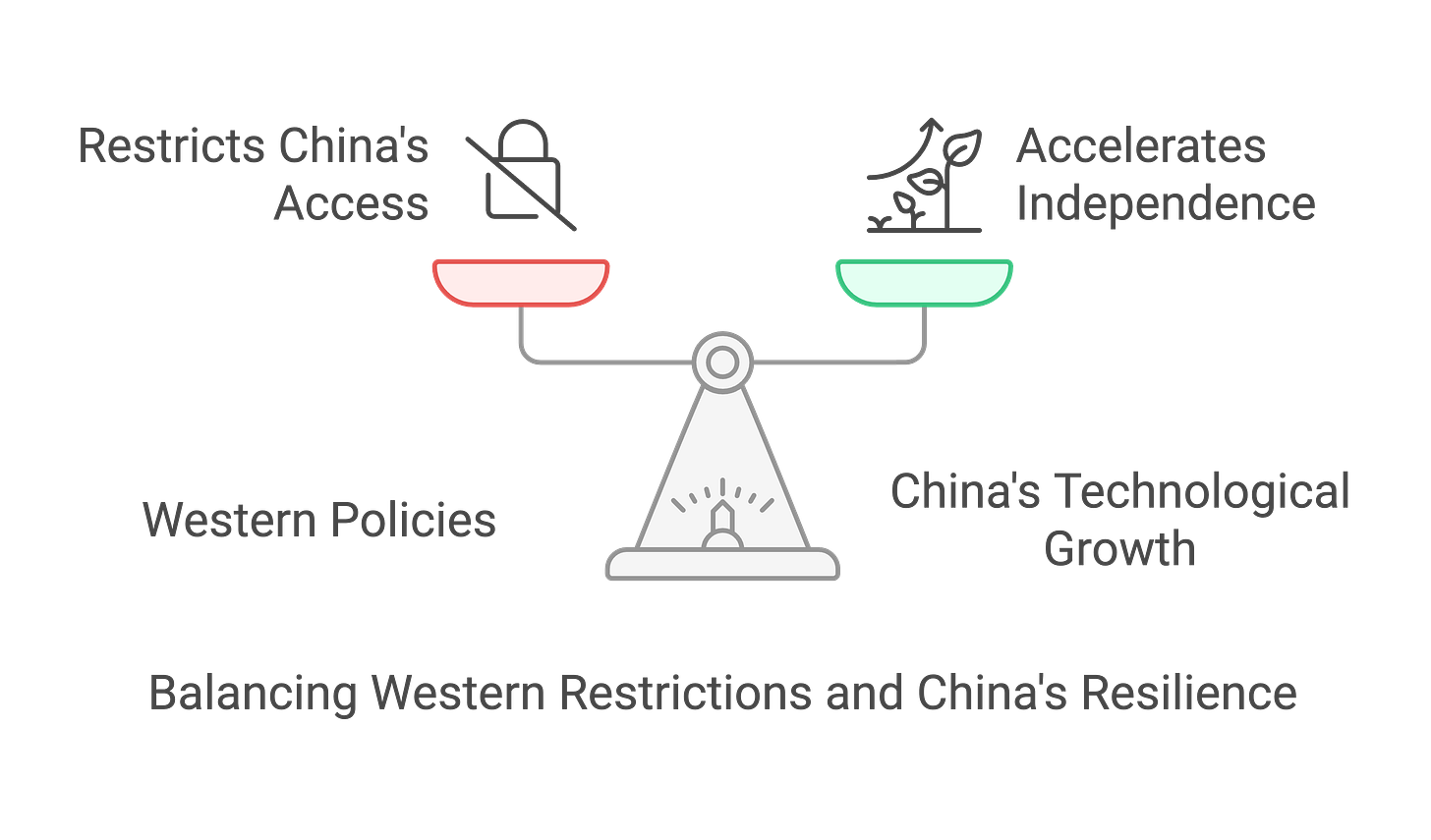
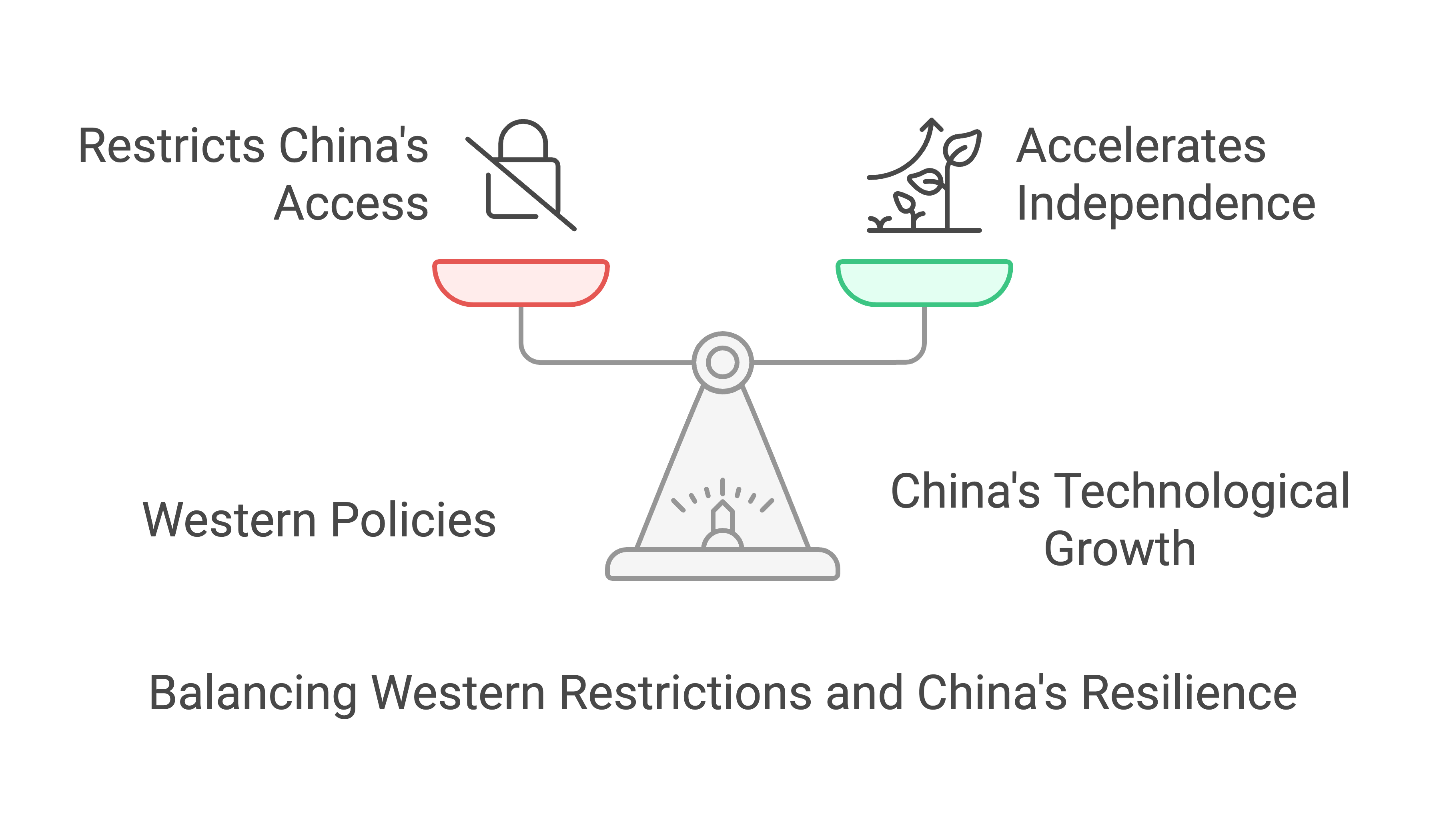
The Strategic Paradox: The More We Block, The More China Builds
Western policy frequently centres on restricting China’s access to AI, semiconductors, and cybersecurity tools—assuming it’ll slow China’s ascendancy.
But it’s quickening their independence:
Huawei, meant to be hamstrung by sanctions, is now producing 7nm chips (Reuters, 2024).
China is “decoupling” from Western tech, building its own AI ecosystems, supply chains, and platforms.
Through Belt & Road, China extends its digital governance norms across the Global South (Hillman, 2021).
And it’s not just China adapting—everyone is:
Brazil is draughting AI and encryption laws, asserting digital sovereignty.
The EU’s Digital Markets Act is reshaping how global tech giants operate, defining distinct regulatory standards.
India, Israel, and South Korea craft AI and cybersecurity policies suited to their national goals.
The Five Dimensions of Digital Power (5D2P): A Framework for Strategic Influence
Rather than simply reacting to China’s AI advances, the West must proactively shape the global digital order. This requires a fundamental shift—from defensive containment to assertive leadership in defining the future of technology. Securing long-term strategic positioning demands investment, innovation, and regulatory influence, not just countermeasures.
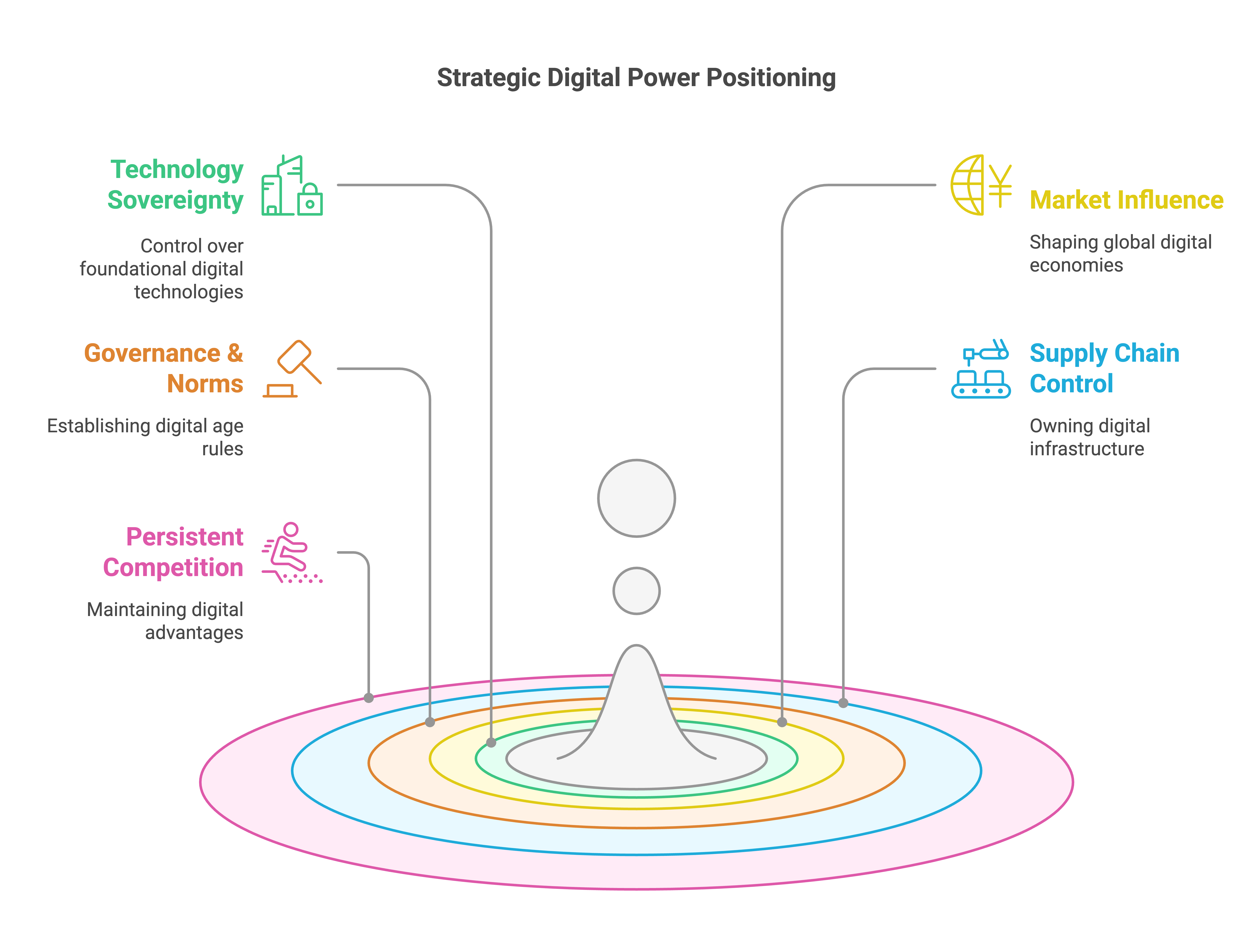
The Five Dimensions of Digital Power (5D2P) offer a strategic lens for understanding how nations compete in the modern tech landscape. By examining these dimensions, we move beyond isolated challenges to a comprehensive strategy—one that strengthens national security, economic influence, and global leadership in an era of digital competition.
1. Technology Sovereignty – Who Controls the Foundations of Digital Power?
The first dimension—technology sovereignty—centres on control over critical technologies such as artificial intelligence, semiconductors, encryption, and cloud computing. A nation’s ability to secure and advance these foundational capabilities determines its resilience and strategic autonomy in an interconnected world. Without self-sufficiency in these areas, dependence on external suppliers creates structural vulnerabilities, exposing economies and national security to geopolitical coercion.
To achieve true technology sovereignty, the West must aggressively invest in next-generation chip design, AI leadership, and cyber security innovation. This will likely require direct government intervention, including strategic subsidies for private firms to ensure technological leadership remains aligned with national interests. The U.S. National Security Commission on AI (NSCAI) Final Report underscores the urgency of these investments, warning that falling behind in AI and semiconductor development could undermine national security (U.S. NSCAI, 2021).
Meanwhile, China’s Made in China 2025 initiative showcases how state-backed investment is actively reducing dependency on Western technology. The recent 7nm chip breakthrough by Huawei—achieved despite U.S. sanctions—demonstrates how strategic investments can accelerate domestic capabilities (Reuters, 2024). The race for technology sovereignty is not just about innovation; it’s about control over the digital and economic future.
2. Market Influence – Who Shapes the Digital Economy?
The second dimension—market influence—determines which nations shape the global AI, cyber, and digital services landscape. Economic power in these sectors isn’t just about financial gains—it translates directly into geopolitical leverage.
A common misconception is that technological dominance is driven solely by state actors. In reality, corporate giants—from Google and Microsoft to Huawei and Alibaba—dictate much of the market direction. At the same time, the European Union wields regulatory influence through the Brussels Effect, exporting its data privacy and technology standards worldwide (Bradford, The Brussels Effect, 2020).
China’s Belt and Road Initiative (BRI) extends its digital footprint through massive infrastructure investments, embedding Chinese digital norms and platforms across Africa, Latin America, and Southeast Asia (Hillman, 2021). This means digital market leadership isn’t just about selling AI models—it’s about controlling the frameworks that govern AI deployment and global digital infrastructure.
3. Governance & Norms – Who Writes the Rules of the Digital Age?
The third dimension—governance and norms—determines who sets the rules for AI security, cyber operations, and digital policy. Nations that lead in shaping digital governance don’t just influence technology; they define how AI is deployed, how cybersecurity threats are mitigated, and what ethical boundaries exist in AI-driven decision-making.
This competition goes beyond national laws—it’s about who establishes global standards. The EU’s General Data Protection Regulation (GDPR) reshaped how companies worldwide handle data, while China’s Cybersecurity Law and Data Security Law force foreign companies to comply with Chinese security requirements, embedding Beijing’s influence into the global digital framework.
As Ian Bremmer notes in Us vs. Them, the fragmentation of governance models reflects a broader geopolitical realignment, where nations shape digital governance to serve their political and economic interests (Bremmer, 2018).
While Western democracies prioritise privacy, decentralisation, and open internet principles, China advocates a state-controlled model, exporting digital authoritarianism through its state-backed tech giants (Kai-Fu Lee, AI Superpowers, 2018). The battle is no longer just about which AI systems dominate—it’s about which governance frameworks will define the future digital order.
4. Supply Chain Control – Who Owns the Infrastructure of the Digital Age?
The fourth dimension of technological competition—supply chain control—underscores the critical need for ownership over hardware, software, and essential raw materials, including rare earth elements and high-performance magnets. As Ed Conway notes in Material World, securing these resources is as vital as mastering semiconductor design (Conway, 2023). Without them, even the most advanced chip architectures remain theoretical exercises.
China currently dominates the global supply chain for rare earth elements, which are indispensable for producing semiconductors, batteries, and AI hardware. This dominance creates a structural dependency that leaves Western technology firms vulnerable to bottlenecks, stalling innovation, and weakening resilience in strategic industries.
While the CHIPS Act aims to restore domestic semiconductor manufacturing in the U.S., it does little to address the upstream dependency on critical raw materials—leaving fundamental supply chain vulnerabilities unaddressed. Compounding this risk is the continued reliance on TSMC in Taiwan and Samsung in South Korea for cutting-edge chip fabrication. These dependencies represent a geopolitical chokepoint—one that could disrupt entire industries if tensions in the Taiwan Strait or Korean Peninsula escalate (Miller, Chip War, 2022). As Chris Miller highlights, whoever controls semiconductor design holds the keys to AI leadership.
Supply chain control is not just about securing raw materials—it extends to infrastructure resilience. Dependence on foreign-owned cloud providers, semiconductor foundries, and networking equipment introduces security risks that cannot be ignored. As global supply chains fragment, so too does the digital ecosystem. The once-monolithic internet is splintering along geopolitical lines, reinforcing the urgency of technological self-sufficiency.
Securing the future isn’t merely about controlling resources—it’s about fortifying infrastructure, diversifying supply chains, and reducing strategic exposure to foreign influence. Without a concerted effort to shore up these vulnerabilities, Western economies risk ceding not just production capacity but also technological leadership itself.
5. Persistent Digital Competition – How Do Nations Secure an Ongoing Advantage?
The final dimension—persistent digital competition—reflects the reality that cyber conflict and AI-driven rivalry are ongoing, not isolated battles with clear winners and losers. Unlike traditional warfare, cyber operations and AI-enabled strategies unfold in real time, continuously reshaping the balance of power across finance, intelligence, and defence.
Nations that effectively integrate cyber security, AI-driven intelligence, and strategic disinformation gain a sustained advantage. The U.S., China, and Russia all engage in cyber espionage, influence operations, and AI-enhanced intelligence gathering—not to achieve immediate victories, but to gradually erode adversaries’ strengths and shape the future digital landscape to their benefit.
This competition extends beyond national security—it’s a struggle for economic and ideological dominance. AI-generated disinformation, financial cyberattacks, and algorithmic decision-making in warfare are no longer hypothetical threats; they are emerging tools of statecraft, forcing governments and industries into a state of continuous adaptation.
As Jonathan Hillman argues in The Digital Silk Road, China’s push for digital infrastructure dominance isn’t just about economic expansion—it’s about securing long-term strategic leverage through cyber and AI-enabled influence (Hillman, 2021). In this environment, digital resilience is no longer optional—it’s the foundation of geopolitical power.
Shaping the Future, Not Just Defending It
It is a misconception to think the semiconductor race alone will determine the outcome of this strategic contest. While chip design and fabrication are crucial, raw materials, open-source innovation, and private-sector influence play equally important roles. There is no single solution that guarantees dominance in this evolving digital landscape.
If the West hopes to lead, it must move beyond reactive policies like banning Chinese AI models or restricting access to key technologies. Instead, it must proactively define the digital ecosystem, ensuring that democratic values, technological sovereignty, and economic security remain at the forefront.
Whether through policy, investment, or market strategy, nations must play a long game—not checkers, but Go—positioning themselves to set the rules of the next digital age rather than reacting to the moves of others.
Apple’s encryption standoff in the UK exemplifies how governments can compel Big Tech to align with national priorities—touching privacy, autonomy, and global rule-setting. This microcosm captures the larger puzzle: Who truly governs our digital future?
Beyond AI and cyber, the horizon promises quantum computing, biotech, and outer space technology—all potential new battlegrounds. If we remain bogged down in reactive bans, we risk repeating these missteps in the next domain.
(Another Bias: We may lean on a zero-sum mindset—one side’s gain is the other’s loss. Yet areas like AI ethics or climate tech could benefit from partial cooperation.
Final Thoughts
This digital battlefield isn’t simply about AI—it’s about who writes the rules of the 21st century. The checkers-vs.-Go analogy may not perfectly reflect real geopolitics, but it does reveal how short-term tactics differ from sustained strategic power.
Ultimately, the West must pick: either shape the digital ecosystem with foresight and collaboration or cling to reactive bans that let others dictate the future. As someone bridging Western markets and Chinese perspectives, I believe realpolitik can still incorporate cooperation and innovative ideals—it simply demands intentional effort to script the next digital chapter instead of reading lines someone else has already written.
Personally, reconciling my commitment to global collaboration with a security-first lens means recognising that national advantage and collective progress aren’t always mutually exclusive. We must choose carefully which battles need strict regulation and which areas—like AI for healthcare or climate research—benefit from cross-border partnership. Doing so might prevent Apple-like showdowns in the future and allow us to harness technology for a more balanced, cooperative world.
(Epilogue: Yes, the map isn’t the territory; real geopolitics is messy and diverse. But if we chase illusions of simple, quick wins, we’ll overlook deeper supply chain complexities, raw material dependencies, private sector power, and the truth that neither China nor the West is monolithic. Recognising these nuances is the first step in forging a more balanced digital future.
References
Kai-Fu Lee, AI Superpowers: China, Silicon Valley, and the New World Order. Houghton Mifflin Harcourt, 2018.
[Washington Post article on Apple’s encryption backdoor (2025)]
Ian Bremmer, Us vs. Them: The Failure of Globalism. Portfolio, 2018.
[Reuters article on Huawei producing 7nm chips]
Jonathan E. Hillman, The Digital Silk Road: China’s Quest to Wire the World and Win the Future. Centre for Strategic and International Studies, 2021.
Chris Miller, Chip War: The Fight for the World’s Most Critical Technology. Simon & Schuster, 2022.
U.S. National Security Commission on AI (NSCAI) Final Report. March 2021.
Ed Conway, Material World: The Myth of Progress and the Reality of the Resource Crunch. [Knopf Doubleday Publishing Group, 2023]